

TP-Compliant NC80 Speed Limiter
CAN-based installation for better reliability and proof of compliance per vehicle.
CAN-based (no crude signal cutting)
Smoother drivability, fewer faults
Installation time: 1 - 1.5 hours (vehicle dependent)


5-Year
Warranty
Warranty

Non-Invasive
Method
Method

Configured to
60 km/h limit
60 km/h limit
BENEFITS
Why CAN-based speed limiter is better than traditional limiter
Traditional limiters often feel like a "brick under the pedal"—they can be jerky and require invasive cutting of your vehicle's original wiring. A CAN-based system is smarter and smoother because it communicates digitally to gently adjust power exactly when needed.
Best for vehicles with accessible CAN/ECU data. If your model isn’t suitable, we’ll advise the correct approach upfront.
Best for vehicles with accessible CAN/ECU data. If your model isn’t suitable, we’ll advise the correct approach upfront.
Cleaner install (less invasive wiring)
Your vehicle stays "original" with no messy, permanent modifications.
More stable behaviour (less jerky cut-off)
No more annoying "jerks" or loss of power when you hit the speed limit.
How NC80 works
NC80 limits speed using vehicle CAN / ECU data (where supported) for smoother compliance and cleaner installation.
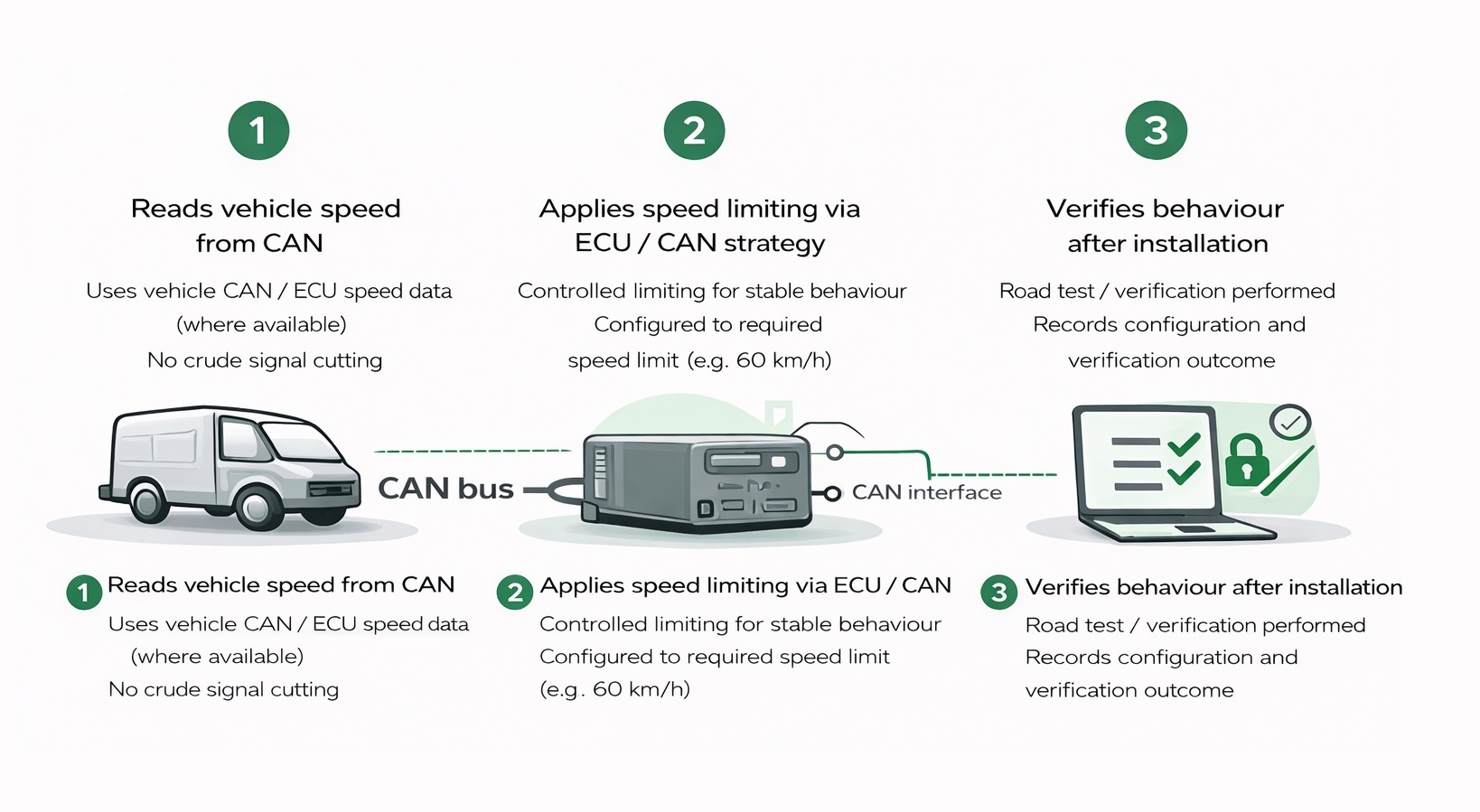
See the Proof & Documentation page for the records issued after installation and verification.
FAQ
Questions fleet owners ask before they commit
Clear answers on compatibility, drivability, downtime, and audit readiness.
Will NC80 work on my vehicle?
NC80 works best on vehicles with accessible CAN/ECU speed data. If your model isn’t supported, we’ll recommend the correct limiter method upfront—so you don’t waste time or risk faults.
Will this affect drivability (jerky cut-off / loss of power)?
NC80 limits speed through controlled ECU/CAN strategy (where supported), which typically feels smoother than crude signal-cut methods. We configure it to meet the required speed limit while maintaining stable throttle response.
Do you cut or splice original wires?
NC80 installations are designed to be non-invasive where possible. The goal is a clean install that avoids unnecessary wire cutting and reduces risk of rework.
What if my vehicle has no CAN support?
Then NC80 may not be the right choice. We’ll advise the suitable approach based on your vehicle model and compliance requirement—so you get a compliant outcome, not “one-size-fits-all”.
How long does installation take and what’s the downtime?
Most installations are scheduled with approximately 1 - 1.5 hours turnaround, but timing depends on vehicle model and any on-site verification needed. We’ll confirm the expected downtime before you commit.
What documents do I receive after installation?
You’ll receive an audit-ready documentation set (e.g., configuration record + verification outcome). This helps your team demonstrate compliance during checks and internal reviews.
Check Proof & Documentation page
Check Proof & Documentation page
Can drivers bypass it?
We configure NC80 to make compliance predictable and consistent. If you want stronger operational control, we can advise on add-ons like monitoring and alerts (depending on your setup).
Does it trigger engine faults or warning lights?
Risk depends heavily on vehicle compatibility and install method. That’s why we verify suitability first—using the correct interface reduces fault risk compared to “universal” approaches.
Is it suitable for mixed fleets (different makes/models)?
Yes—many fleets run mixed vehicles. The key is choosing the right method per vehicle, then documenting it consistently so your compliance process stays clean.
What warranty do I get with NC80?
NC80 comes with a 5-year warranty. Coverage applies under normal use and installation/configuration per our specifications. Warranty terms, exclusions, and support process are documented so there’s no ambiguity when service is needed.
View Support & Warranty
View Support & Warranty
What happens if there’s an issue later—who supports it?
You deal with one accountable party for support. If a warranty issue arises, we follow a documented process (fault check → configuration review → rectification path) so downtime and finger-pointing are minimized.
NC80 includes warranty-backed support after installation. See our Support & Warranty page for coverage and post-install assistance.
NC80 includes warranty-backed support after installation. See our Support & Warranty page for coverage and post-install assistance.
How much does NC80 installation cost?
Installation cost depends on vehicle type, installation scope, and the supporting records required. See our Cost & Quote page for pricing guidance.