

Singapore Speed Limiter Compliance Requirements (TP)
Eligibility, deadlines, enforcement, and the documentation
needed for inspection and audit.
Who Needs a Speed Limiter in Singapore?
Speed limiter requirements in Singapore are rolled out in phases. Compliance is checked through Traffic Police (TP) roadside inspections and, for some fleets, audit documentation requirements from 1 Jan 2026 (bizSAFE 3/4/STAR). If you’re unsure, confirm eligibility before booking.

Traffic Police roadside inspection checks (what they verify at 60 km/h)
TP checks may include correct installation, confirmed 60 km/h configuration, tamper resistance, and supporting documentation. Keep an inspection-ready proof pack so your fleet can respond fast during checks.
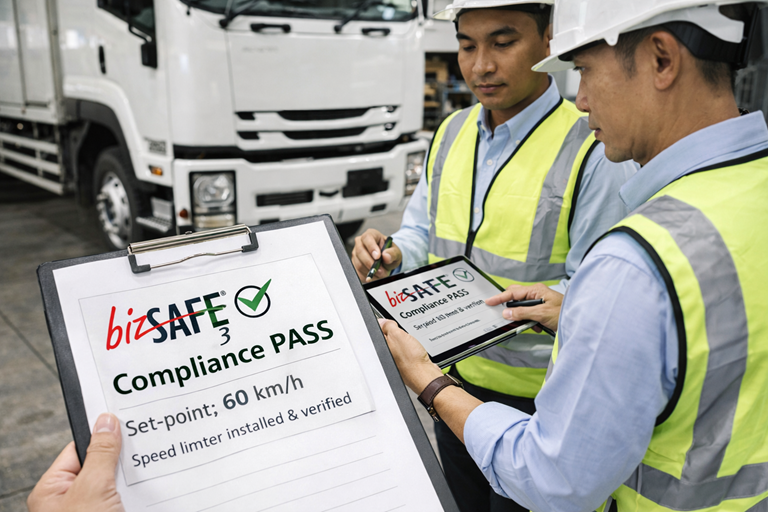
bizSAFE 3/4/STAR audit evidence
(from 1 Jan 2026)
From 1 Jan 2026, fleets pursuing bizSAFE certification may need to show implemented controls and evidence. That means installation records, speed verification results, and documentation that proves ongoing compliance.
Step-by-step compliance checks (TP roadside + audit readiness)
Understand what gets verified in Singapore—during Traffic Police roadside inspections and during audits—so your fleet can respond fast with the right documentation and speed verification records.
Want us to confirm eligibility and the documents you’ll need?
Share your vehicle details and we’ll advise the correct compliance approach and what to prepare for TP inspection checks and documentation review.
Once eligibility is confirmed, the next step is to review installation scope and quotation. See our Cost & Quote page.
Want us to confirm eligibility and the documents you’ll need?
Share your vehicle details and we’ll advise the correct compliance approach and what to prepare for TP inspection checks and documentation review.
Once eligibility is confirmed, the next step is to review installation scope and quotation. See our Cost & Quote page.
Vehicle eligibility assessment (category + deadlines)
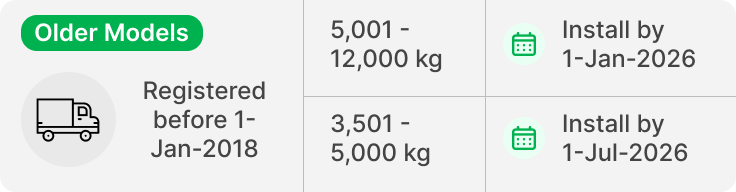
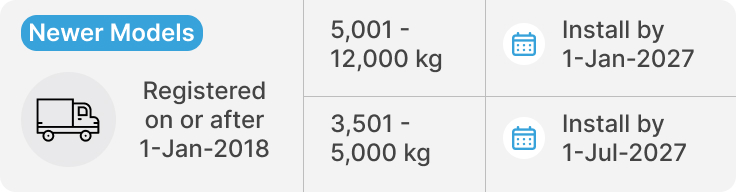
Confirm whether the vehicle falls under the phased regime and timeline. Eligibility is based on vehicle profile and regulatory deadlines, and it determines what compliance approach and documentation will be required.
Evidence & documentation readiness (before inspection day)
Don’t treat this like “just hardware.” Inspections and audits often fail fleets due to missing records. Prepare an inspection-ready proof set (installation record, configuration details, and supporting documents) so you can produce it quickly when requested.
Speed configuration to the mandated limit (60 km/h)
Compliance depends on correct speed configuration and traceable records. The goal is simple: your vehicle should not exceed the mandated limit, and you should be able to show how and when it was configured.
See the NC80 speed limiter used for compliant installation, speed configuration, and verification support.
Speed verification + proof pack issuance
After configuration, speed verification is performed and recorded. Your proof pack should include verification results and documentation that supports follow-up checks, inspections, and audit reviews.
Ongoing compliance
(records you can re-produce anytime)
Roadside checks and audits are about repeatability. Keep your records organised so fleet managers can respond quickly, especially when vehicles rotate drivers, change workshops, or undergo follow-up inspections.
What Traffic Police and audits look for
(and what compliant fleets must have)
Compliance is proven with verification + records — not just a device on the vehicle.

Certified installation
(authorised workflow)
Installation must follow an authorised process with traceable job details and technician accountability.

Verified 60 km/h configuration (recorded)
Speed configuration must be verified and the result recorded for inspection and follow-up checks.

After-install remediation support (if checked later)
If a fleet is inspected or flagged later, you need a clear remediation path: re-check, re-verify, update records.
Inspection-ready proof pack
(what you should receive)

Proof of Installation
(work order + photos)

Speed Verification Record (results + date)

Installation Checklist (method + notes)

Warranty & Support Reference (for follow-ups)
Common non-compliance issues that cause failures
Unclear method / inconsistent installation
No recorded verification result
Poor traceability (missing photos / job details)
Repeat tuning / unstable drivability complaints
Insufficient documents when evidence is requested
Minimum compliant approach (recommended)
Use CAN-based integration where supported (reduce intrusive wiring)
Apply correct method by vehicle model
Complete speed configuration + verification
Record results and issue proof pack
Keep documents ready for inspections / audits
Next step: confirm eligibility and required proof pack for your vehicle.
Deadlines & Phased Rollout
(By Vehicle Category)
Based on Singapore traffic police phased rollout announcement and bizSAFE 3/4/STAR audit requirement (effective 1 Jan 2026)
Use MLW and registration date to confirm your compliance deadline. If unsure, run the eligibility check—don’t guess.
What happens if:
Use MLW and registration date to confirm your compliance deadline. If unsure, run the eligibility check—don’t guess.
What happens if:
Missed deadline: higher chance of enforcement issues / audit failure
Fail inspection/audit: re-check + re-verify + update records
No proof pack: you can be “installed” but still “non-compliant”
If your vehicle category is affected, review our Cost & Quote page to understand installation scope and pricing.
Vehicle Registration
MLW range (kg)
MLW range (kg)
Before 1 Jan 2018
On or after 1 Jan 2018
5001 - 12,000
(e.g. 24 ft lorry)
(e.g. 24 ft lorry)
Install by
1 Jan 2026
1 Jan 2026
Install by
1 Jan 2027
1 Jan 2027
3501 - 5000
(e.g. 14 ft lorry)
(e.g. 14 ft lorry)
Install by
1 July 2026
1 July 2026
Install by
1 July 2027
1 July 2027
<3501
(e.g 10 ft lorry)
(e.g 10 ft lorry)
Next bizSAFE renewal date
Fast examples

24-ft Lorry
YN8766L
Registered 2009
MLW 10,000 kg
Deadline: 1 Jan 2026

14-ft Lorry
YP1123C
Registered 2017
MLW 3,780 kg
Deadline: 1 July 2026

10-ft Lorry
GBH7784Z
Registered 2020
MLW 3,250 kg
Deadline: Next bizSAFE renewal date
Speed Limiter Requirements FAQ (Singapore)
Clear answers on eligibility, deadlines, inspections, and required documentation.
What vehicles are required to install a speed limiter in Singapore?
Lorries within specific Maximum Laden Weight (MLW) categories are required to install speed limiters under the Traffic Police phased rollout.
Generally, vehicles between 3,501 kg and 12,000 kg MLW fall within the regulated categories. Deadlines depend on:
- MLW range
- Vehicle registration date
- Applicable rollout phase
Always confirm using your vehicle registration details rather than relying on general assumptions.
Generally, vehicles between 3,501 kg and 12,000 kg MLW fall within the regulated categories. Deadlines depend on:
- MLW range
- Vehicle registration date
- Applicable rollout phase
Always confirm using your vehicle registration details rather than relying on general assumptions.
How do I check my vehicle’s MLW?
MLW (Maximum Laden Weight) is stated in your vehicle log card or registration records.
It refers to the maximum legally permitted weight of the vehicle when fully loaded, not the empty vehicle weight.
Speed limiter requirements are based on MLW — not vehicle length or engine size.
It refers to the maximum legally permitted weight of the vehicle when fully loaded, not the empty vehicle weight.
Speed limiter requirements are based on MLW — not vehicle length or engine size.
Does registration date affect the compliance deadline?
Yes.
Under the phased rollout, vehicles registered before and after specific cutoff dates may have different installation deadlines.
Two vehicles with the same MLW can have different deadlines depending on when they were first registered.
Always confirm based on:
- MLW category
- First registration date
Under the phased rollout, vehicles registered before and after specific cutoff dates may have different installation deadlines.
Two vehicles with the same MLW can have different deadlines depending on when they were first registered.
Always confirm based on:
- MLW category
- First registration date
What speed must the limiter be configured to?
For regulated lorries, the mandated limit is 60 km/h.
Compliance requires:
- Correct configuration to the mandated limit
- Verified speed testing
- Recorded verification results
It is not sufficient to “install” the device — configuration must be documented.
Compliance requires:
- Correct configuration to the mandated limit
- Verified speed testing
- Recorded verification results
It is not sufficient to “install” the device — configuration must be documented.
What documents must I produce during a roadside inspection?
During Traffic Police inspection, you may be required to show:
- Proof of installation (work order / photos)
- Speed verification record
- Configuration details
- Supporting documentation upon request
Compliance is demonstrated through records, not just the presence of a device.
- Proof of installation (work order / photos)
- Speed verification record
- Configuration details
- Supporting documentation upon request
Compliance is demonstrated through records, not just the presence of a device.
What do bizSAFE 3/4/STAR audits look for from 1 Jan 2026?
From 1 January 2026, fleets undergoing bizSAFE 3/4/STAR audits must demonstrate documented risk controls.
For regulated lorries, auditors may check:
- Installation traceability
- Speed configuration verification
- Documentation records
- Evidence of ongoing compliance
This means documentation readiness becomes critical.
For regulated lorries, auditors may check:
- Installation traceability
- Speed configuration verification
- Documentation records
- Evidence of ongoing compliance
This means documentation readiness becomes critical.
What happens if my vehicle fails inspection?
If a vehicle fails inspection, corrective actions may include:
- Re-verification of speed configuration
- Rectification of installation method
- Updating documentation records
- Repeat inspection
Delays can impact operational scheduling and audit outcomes.
- Re-verification of speed configuration
- Rectification of installation method
- Updating documentation records
- Repeat inspection
Delays can impact operational scheduling and audit outcomes.
Is installing a speed limiter enough to be compliant?
No.
Compliance requires:
- Correct installation method
- Proper speed configuration
- Verified testing
- Issued documentation
- Record retention
A vehicle can be “installed” but still be non-compliant if verification or documentation is missing.
Compliance requires:
- Correct installation method
- Proper speed configuration
- Verified testing
- Issued documentation
- Record retention
A vehicle can be “installed” but still be non-compliant if verification or documentation is missing.
What are the risks of missing the installation deadline?
Missing the compliance deadline may increase risk of:
- Roadside inspection failure
- Audit non-conformance
- Enforcement action
- Operational disruption
Deadlines should be confirmed early to avoid last-minute rectification.
- Roadside inspection failure
- Audit non-conformance
- Enforcement action
- Operational disruption
Deadlines should be confirmed early to avoid last-minute rectification.
How do I confirm my exact compliance deadline?
To determine your exact deadline, you need:
- Vehicle MLW
- First registration date
- Applicable rollout phase
If unsure, confirm before booking installation to avoid compliance gaps.
- Vehicle MLW
- First registration date
- Applicable rollout phase
If unsure, confirm before booking installation to avoid compliance gaps.
How much does speed limiter installation cost?
Installation cost depends on vehicle type, installation scope, and supporting requirements.
See our Cost & Quote page for pricing guidance.
See our Cost & Quote page for pricing guidance.